%202.svg)
Jaguar Land Rover
Scattered Spider Lapsus$ Hunters custom Ransomware
Manufacturing
~$258M for JLR, ~$2.5B to UK economy, production shutdown for several weeks
Vishing credentials
Weak Credentials and a lack of segmentation
Network Cloaking, Passwordless Access, and Segmentation
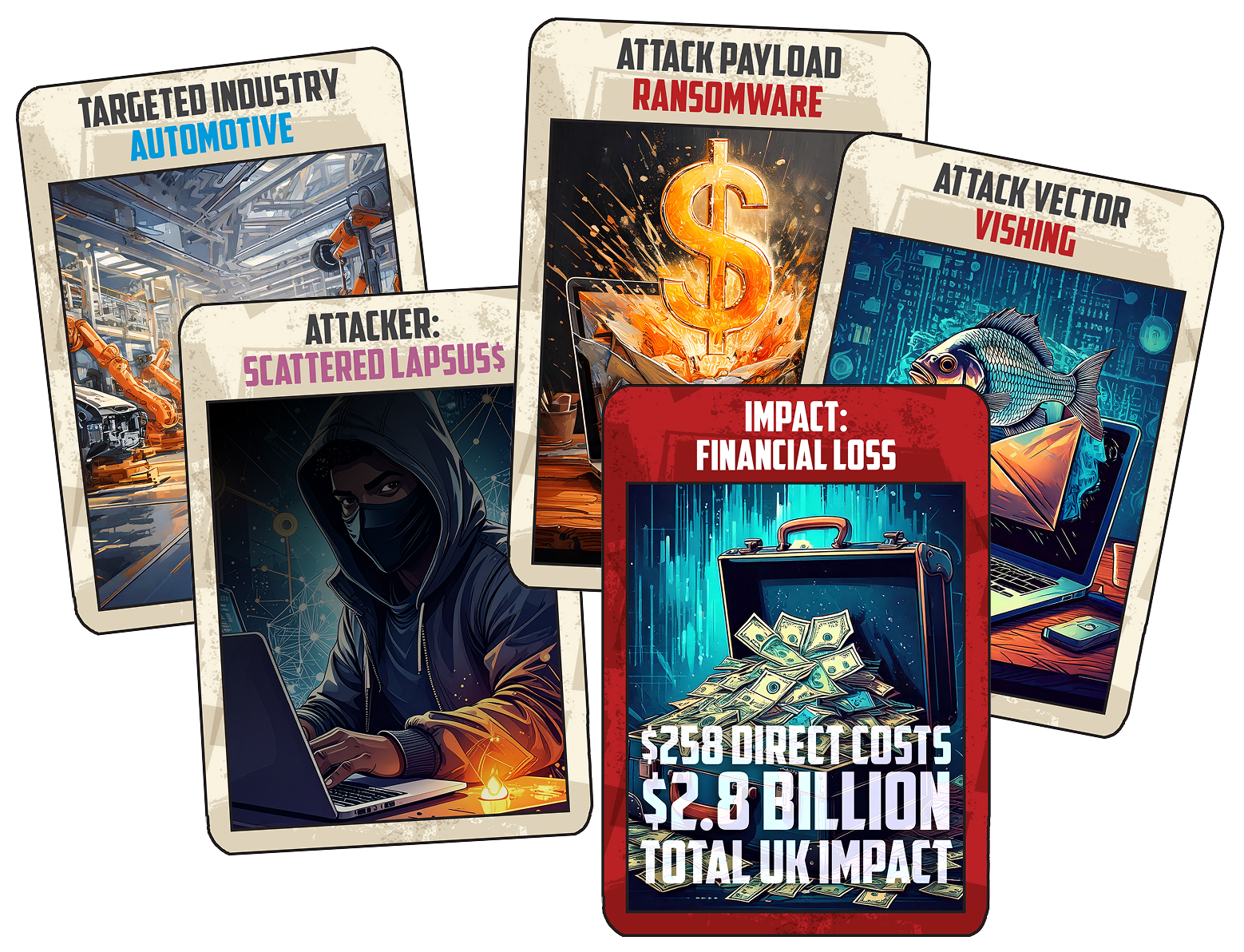
The September 2025 cyberattack on Jaguar Land Rover (JLR) serves as a potent example of how social engineering and credential compromise are often more effective than technical exploits for breaching sophisticated organizations.
Attributed to the Scattered Lapsus$ Hunters collective, the initial access vector is believed to have begun with a vishing call to the IT helpdesk requesting a password reset. This low-tech maneuver successfully bypassed multi-million dollar perimeter defenses by exploiting the single weakest link: human trust and identity verification protocols.
Once inside the corporate network using the fraudulently acquired credentials, the attackers deployed ransomware, which rapidly led to a shutdown of JLR’s three UK production plants for several weeks.
The resulting loss of manufacturing output and disruption to the extensive supply chain led to a direct company loss of £196 million ($258 million) and an estimated total UK economic impact of £1.9 billion ($2.5 billion), demonstrating how initial credential theft cascades into massive operational failure.
The JLR attack highlights two catastrophic failures: the vulnerability of the helpdesk as an entry point, and the implicit trust that allowed the attacker to pivot from the compromised IT user account to the production environment. BlastWave’s Zero Trust architecture would have neutralized both factors:
Credential Invalidation: Even if the attacker successfully resets and acquires the password via vishing, the BlastWave platform mandates cryptographically verif ied device posture and continuous identity validation (MFA, biometrics) before establishing a secure access tunnel. A stolen password, when presented from an unverified, unauthorized device, would be insufficient to establish access, rendering the social engineering effort moot.
Manufacturing Cloaking: Once inside the corporate IT network, the attacker attempted to pivot to disrupt production. JLR’s failure point was the exposed nature of the manufacturing network. BlastWave would enforce that the OT manufacturing controllers and systems are invisible and inaccessible to the compromised IT host. The ransomware or attacker commands would be unable to discover or initiate communication with the production control systems, conf ining the incident to the administrative IT network and preventing the massive, multi-week operational shutdown.


Reading about past failures is only useful if it changes future outcomes. If attackers can see your OT network, they can target it. If they can target it, compliance, safety, and uptime are already at risk.
BlastWave eliminates reconnaissance, initial access, and lateral movement — without agents, without downtime, and without changing IPs, protocols, or PLCs.